
Static polymorphism
🚀 𝐄𝐱𝐩𝐥𝐨𝐫𝐢𝐧𝐠 𝐒𝐭𝐚𝐭𝐢𝐜 𝐏𝐨𝐥𝐲𝐦𝐨𝐫𝐩𝐡𝐢𝐬𝐦 𝐢𝐧 𝐂++ 𝐰𝐢𝐭𝐡 𝐅𝐮𝐧𝐜𝐭𝐢𝐨𝐧
𝐎𝐯𝐞𝐫𝐥𝐨𝐚𝐝𝐢𝐧𝐠
🚀
Have you ever pondered how C++ employs static polymorphism to determine the most specific function
during overloading?
Let's delve into the intriguing realm of function overloading, highlighting the potency of static
polymorphism and
underscoring the systematic approach of the compiler in selecting the nearest match!
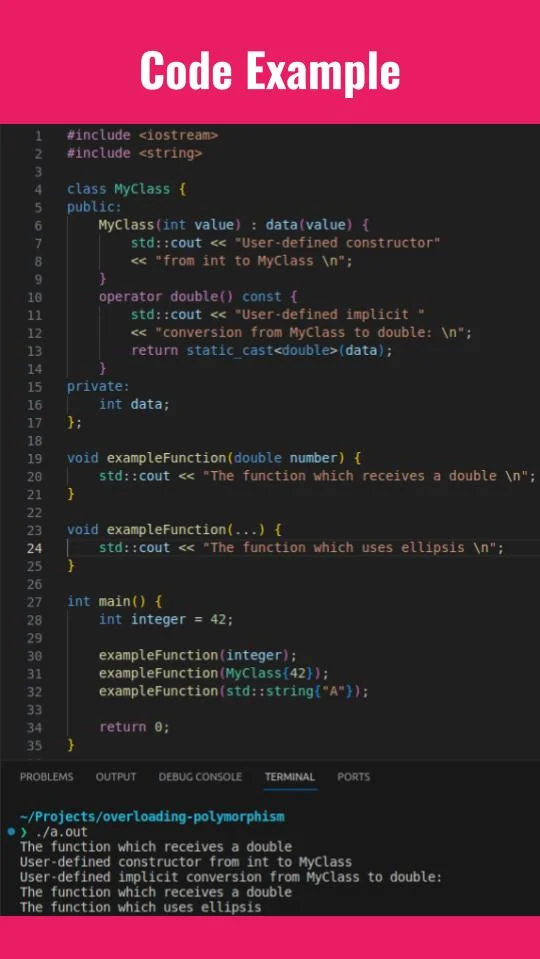
✴️ 𝐂𝐨𝐝𝐞 𝐒𝐧𝐢𝐩𝐩𝐞𝐭: 𝐞𝐱𝐚𝐦𝐩𝐥𝐞𝐅𝐮𝐧𝐜𝐭𝐢𝐨𝐧() 𝐎𝐯𝐞𝐫𝐥𝐨𝐚𝐝𝐢𝐧𝐠
In the following code snippet, exampleFunction() is overloaded with versions for double and ellipsis
(...). When calling
these functions with different types, C++ intelligently attempts to choose the most suitable one.
1️⃣ 𝐒𝐭𝐚𝐧𝐝𝐚𝐫𝐝 𝐂𝐨𝐧𝐯𝐞𝐫𝐬𝐢𝐨𝐧𝐬:
exampleFunction(integer);
Calls the function for a double, as it's the closest match.
2️⃣ 𝐔𝐬𝐞𝐫-𝐃𝐞𝐟𝐢𝐧𝐞𝐝 𝐂𝐨𝐧𝐯𝐞𝐫𝐬𝐢𝐨𝐧𝐬:
exampleFunction(MyClass{42});
If no direct match is found, gracefully falls back on user-defined conversions.
Calls the user-defined constructor in MyClass.
Invokes the user-defined implicit conversion to double.
Finally, calls the function for a double.
3️⃣ 𝐄𝐥𝐥𝐢𝐩𝐬𝐢𝐬:
exampleFunction(std::string{"Hello"});
When all else fails, the compiler resorts to ellipsis since there isn't a more specific match for a
std::string.
🔴 𝐊𝐞𝐲 𝐏𝐨𝐢𝐧𝐭𝐬 𝐭𝐨 𝐂𝐨𝐧𝐬𝐢𝐝𝐞𝐫:
➤ Notice the use of 𝐬𝐭𝐚𝐭𝐢𝐜 𝐩𝐨𝐥𝐲𝐦𝐨𝐫𝐩𝐡𝐢𝐬𝐦, where the function to be called is determined
at
𝐜𝐨𝐦𝐩𝐢𝐥𝐞 𝐭𝐢𝐦𝐞 based on the type of the argument.
➤ 𝐃𝐲𝐧𝐚𝐦𝐢𝐜 𝐩𝐨𝐥𝐲𝐦𝐨𝐫𝐩𝐡𝐢𝐬𝐦 is typically associated with classes and inheritance (e.g.,
virtual
functions), involving resolving the function call at 𝐫𝐮𝐧𝐭𝐢𝐦𝐞.
➤ Observe the sequence followed: 𝐬𝐭𝐚𝐧𝐝𝐚𝐫𝐝 𝐜𝐨𝐧𝐯𝐞𝐫𝐬𝐢𝐨𝐧𝐬, 𝐮𝐬𝐞𝐫-𝐝𝐞𝐟𝐢𝐧𝐞𝐝
𝐜𝐨𝐧𝐯𝐞𝐫𝐬𝐢𝐨𝐧𝐬, 𝐚𝐧𝐝 𝐞𝐥𝐥𝐢𝐩𝐬𝐢𝐬.
This meticulous process ensures that the selected function is the closest match for the given arguments.
Witness the
elegance of C++ in handling function overloading and seamlessly adapting to various scenarios! 💻✨
#CPP #C++ #Programming #Polymorphism #OverloadingFunctions