
Copy Constructor
Hello everybody! 👋
😡 Have you ever struggled with the bad behavior of your 𝐜𝐨𝐩𝐲 𝐜𝐨𝐧𝐬𝐭𝐫𝐮𝐜𝐭𝐨𝐫 in C++? Look no
further to
understand WHAT it is, WHERE and WHEN it is called, and WHY sometimes we need to define a custom one.
🤔 𝐖𝐇𝐀𝐓 is a COPY CONSTRUCTOR?
in C++, a copy constructor is used to create a new object that is a copy of an existing object of the
same class. It
receives a constant reference to the object being copied and is used to replicate the object's state.
The reference is
read-only and should not be modified since it is only used to copy the object's state and not to change
it.
📍 𝐖𝐇𝐄𝐍 and 𝐖𝐇𝐄𝐑𝐄 is the COPY CONSTRUCTOR normally called?
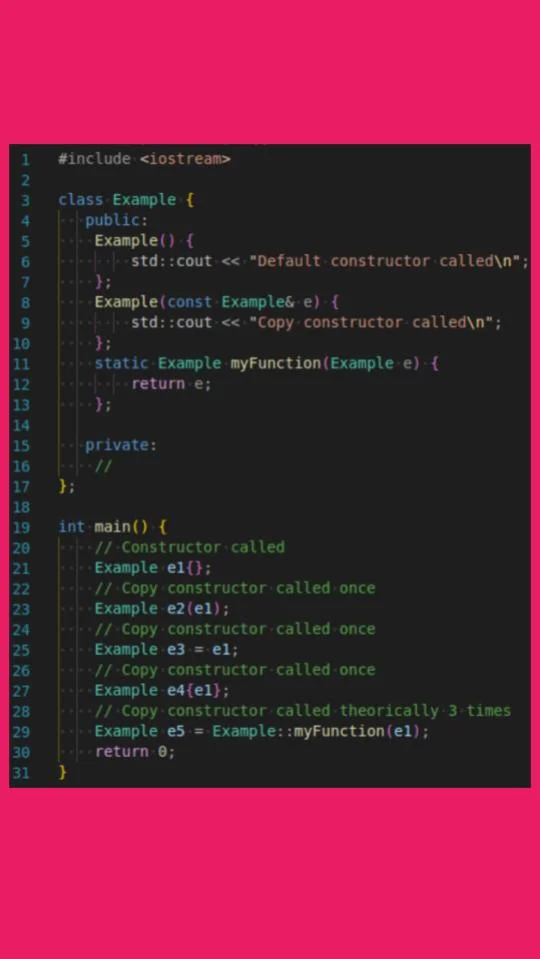
The copy constructor is called in three situations:
• When a new object is created from an existing object of the same class
• When an object is passed by value as a parameter to a function: it means that the actual parameters
are copied to the
formal parameters.
• When an object is returned by value from a function: furthermore, when a method reaches the return
statement and
returns a value by value.
⚠️ 𝐋𝐢𝐧𝐞 29: in the example showcases the copy constructor is called three times during the
initialization of e5,
which could be optimized by the compiler to call it only twice.
𝐔𝐬𝐞 “-𝐒” arguments when compiling your code in order to get the assembly code and find out whether
your compiler
might be optimizing it somehow.
I’d also recommend to look up you these concepts: Return Value Optimization (𝐑𝐕𝐎) or Named Return
Value Optimization
(𝐍𝐑𝐕𝐎) and 𝐂𝐨𝐩𝐲 𝐄𝐥𝐢𝐬𝐢𝐨𝐧.
💡 𝐖𝐇𝐘 sometimes do we need to define a CUSTOM COPY CONSTRUCTOR??
The default copy constructor works the same as copying structures in C, which means copying value by
value. However,
this default copy constructor doesn't always work well with all classes, and some classes may require
additional
operations such as detecting error conditions, allocating memory, or releasing it. In such cases,
relying on the default
copy constructor or assignment operator provided by the compiler would be inadequate, and custom
implementation may be
necessary.
Whenever we define a copy constructor, we must also define the copy assignment operator because both
ultimately perform
copying, and both can be equally good or bad. For example, when we need to copy a simple data type like
an integer, we
don't have to do anything special, just copy it. But when we have an attribute of type pointer to
character, i.e., an
attribute that stores the memory address where the vector begins, we need to define a copy constructor
and assignment
operator. Otherwise, we will have a problem with aliasing, and when we modify one of these 2 objects,
one copied from
the other, we will be directly modifying both since those two pointers are identical. We could also get
segmentation
violations or unexpected runtime errors by accessing forbidden memory addresses.
Thanks for reading!! 👨💻
#embedded #c++ #programming